Key Takeaways
- In the 1870s, the Horrell brothers gained a reputation for heavy drinking, gunfights, and violent raids.
- Their notoriety collided with the stern discipline of Pink Higgins after Higgins killed Merritt Horrell in a saloon.
- The feud that followed left more than a dozen men dead and largely burned out by late 1877.
A Town on Edge
In the 1870s, Lampasas was a frontier town trying to grow into respectability. The courthouse square drew ranchers and cattlemen from miles around, and the saloons stayed busy. It was also a place where disputes had a way of turning violent. That decade, the town became the stage for a feud between two families whose names Texans wouldn’t soon forget—the Horrells and the Higginses.
Reputations and Tempers Collide
The five Horrell brothers—Mart, Tom, Merritt, Ben and Sam—were best known for their drinking and their trouble with the law. They had tangled with officers in Lampasas and even carried their fights west into New Mexico, where they were linked to cattle thefts and shootings.
The Higgins family had a different standing. John P. “Pink” Higgins worked as a rancher and stock detective, and he quickly earned a reputation in Lampasas County as a dead-shot with a rifle. Where the Horrells were seen as rowdy and reckless, Pink Higgins was viewed as hard-edged and determined to keep order on his own terms.
Though both families operated in and around Lampasas County, they represented two sides of frontier life: one chaotic and lawless, the other stern and uncompromising.
Raids and Rising Tensions
The first sparks flew in the early 1870s, when the Horrell brothers clashed with Texas lawmen. On March 14, 1873, Captain Thomas G. Williams and his Texas State Police entered Lampasas. In a saloon gunfight that erupted with the Horrells, four officers ultimately succumbed to the violence—Williams, along with Privates James M. Daniels, Wesley Cherry, and Andrew Melville.
The trouble escalated when members of the Horrell clan moved to Lincoln County, New Mexico, where they became embroiled in cattle disputes and bloody raids against Hispanic settlers. Their reputation for violence grew, and by the time they returned to Lampasas, the Horrells were already infamous.
Meanwhile, the Higgins family was gaining influence in Lampasas. With their connections to local ranchers and lawmen, they were positioned as a counterweight to the Horrells’ rowdy dominance. It was only a matter of time before the two groups collided.
Blood in the Square
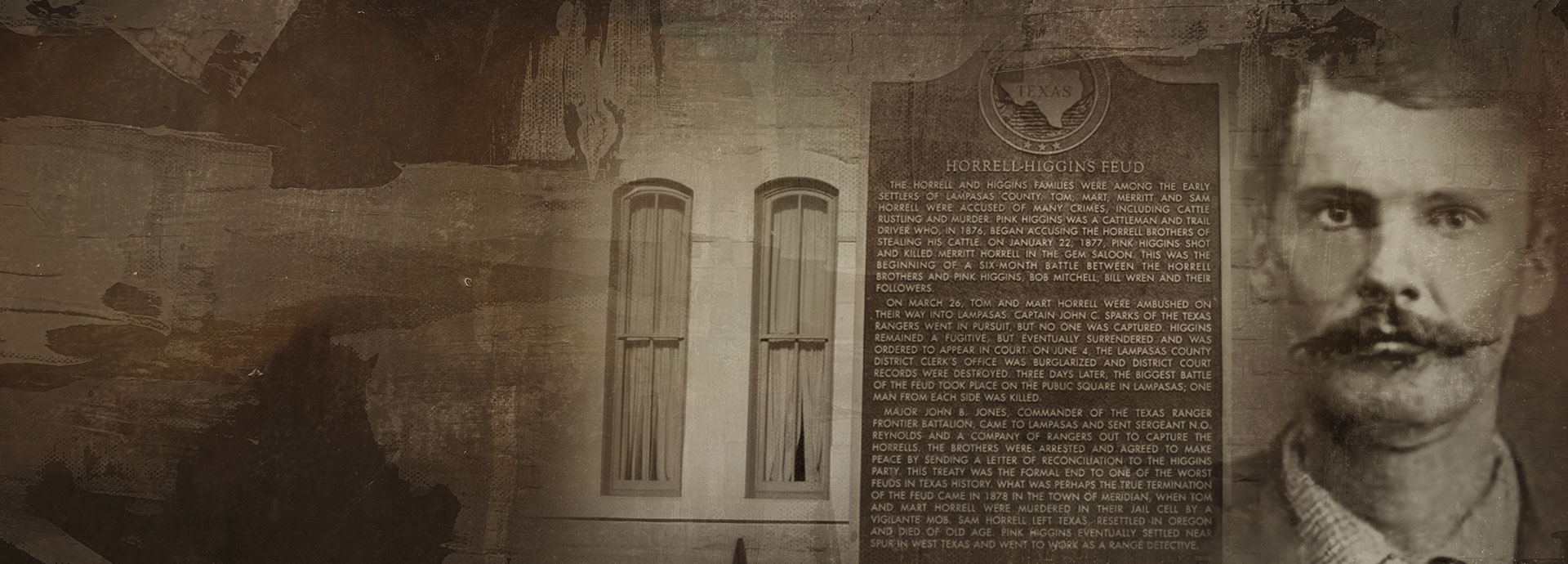
The feud erupted on Jan. 22, 1877, when a skirmish between the families turned deadly, claiming the life of Merritt Horrell in a Lampasas saloon shootout. The killing, widely attributed to Pink Higgins, set off a cycle of retribution.
Over the following months, gunfights broke out across Lampasas County. Men from both families, along with their allies, exchanged bullets in saloons, streets, and pastures. On June 7, 1877, one of the bloodiest clashes broke out in the Lampasas town square, killing multiple men in a crossfire that left the community shaken. Contemporary reports put the death toll at between 14 and 17 men, nearly all tied to the Horrell or Higgins camps.
A Community Weakened
The violence came to a head in summer 1877, when a running gun battle spilled into the Lampasas town square. Fearing the feud would drag the whole county into chaos, the Texas Rangers moved in. On July 30, Ranger Major John B. Jones gathered men from both sides and forced an agreement to lay down arms. The peace didn’t last long, but over the next year the Horrell brothers were killed in separate fights, one after another, and their hold on the county was finished.
Pink Higgins, however, survived the feud and went on to build a lasting reputation as a gunfighter and rancher. He died Dec. 18, 1913, and is remembered as one of the few men to walk away from the deadly rivalry unscathed.
A Texas-Sized Legacy
The Horrell-Higgins feud was short, but its violence left Lampasas with a reputation that lingered long after the shooting stopped. Court records, newspaper reports, and Ranger files kept the story alive, and in Lampasas it passed into local lore.
Pink Higgins outlived the feud and carried his reputation as a marksman and rancher into the new century. The Horrells were not so fortunate—their name became linked with the violence that shook Lampasas in the 1870s. Folks in Central Texas didn’t forget, and the tale has stayed alive in courthouse steps, campfire stories and the pages of Texas history.
Suggest a Correction
We strive for accuracy and fairness. But if you see something that doesn’t look right, click here to contact us!

About the Author
Reagan Johnson has spent more than 20 years in television, publishing, and marketing, with the last four as a contributing writer, content strategist, and editor for INSP. Her travel writing has appeared in Forbes Travel Guide, Smithsonian Magazine, MSNBC Travel, Jetsetter, ISLANDS, and Weddings Unveiled, along with custom content for clients including Oil Nut Bay and Brand USA. She has served as travel editor-at-large and digital content fact-checker for Smithsonian Magazine’s native travel features. Reagan also manages a boutique marketing agency specializing in travel, hospitality, and tourism brands, blending editorial expertise with strategic insight to create engaging, audience-focused content.